
Table of Contents
If you buy industrial spares for U.S. power plants, substations, EPC jobs, or MRO programs, tariff refunds, including IEEPA tariff refunds 2026, are not an accounting footnote. They affect landed cost, margin recovery, project reporting, and sometimes supplier credibility. In March 2026, many import teams are asking the same question: what should we do now that the White House ended certain IEEPA additional ad valorem duties, but the refund mechanics are still being operationalized?
Many importers are now closely watching developments around IEEPA tariff refunds 2026 as legal challenges move through the courts.
This article is for procurement managers, import compliance teams, brokers, plant buyers, project controls staff, and finance teams that handled routine industrial imports in 2025 and early 2026. The examples fit the items your buyers actually touch: valves, actuators, bearings, instrumentation, gaskets, fasteners, electrical accessories, relay hardware, control panels, and maintenance kits.
What officially changed in February 2026
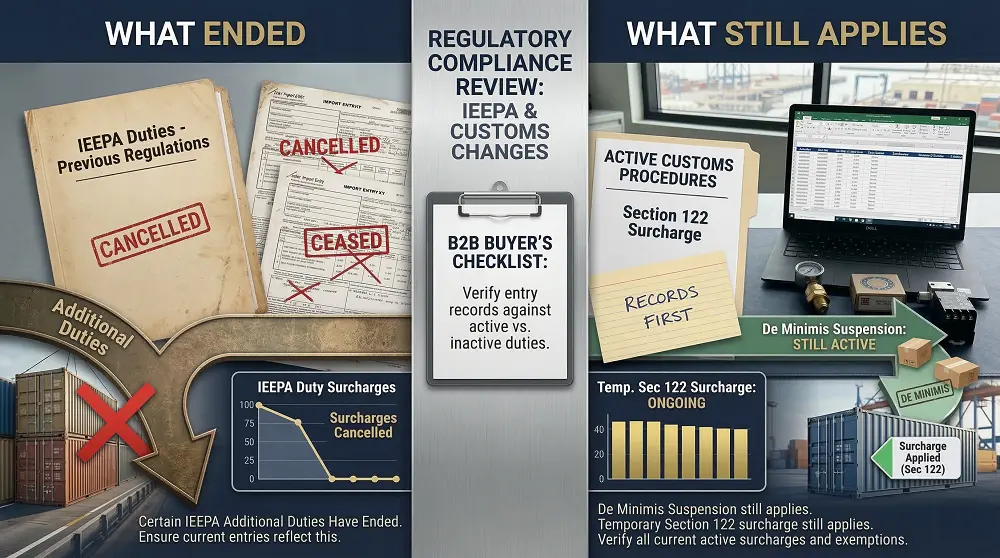
On February 20, 2026, the White House issued the Executive Order titled “Ending Certain Tariff Actions.” The order says the additional ad valorem duties imposed under multiple IEEPA-based executive orders shall no longer be in effect and, as soon as practicable, shall no longer be collected.
Analysts believe IEEPA tariff refunds 2026 could become a major issue for companies that paid emergency import duties earlier in the year.
That point matters because many teams are still speaking loosely about ‘all emergency tariffs’ as if one single switch was turned off. That is not accurate. The February 20 order is specific to the additional ad valorem duties imposed under the listed IEEPA actions.
What did not end
The same White House order also says two other measures were unaffected: the February 20, 2026 continuation of the suspension of duty-free de minimis treatment for all countries, and the February 20, 2026 proclamation imposing the temporary Section 122 import surcharge.
So if your plant or EPC buyer imported small urgent spares and expected all recent trade pain to disappear, that would be the wrong reading. One set of IEEPA additional duties ended. Other cost and entry pressures remained in place.
Procurement teams should document every shipment carefully in case IEEPA tariff refunds 2026 become available.
IEEPA tariff refunds 2026 – Why this matters to industrial importers
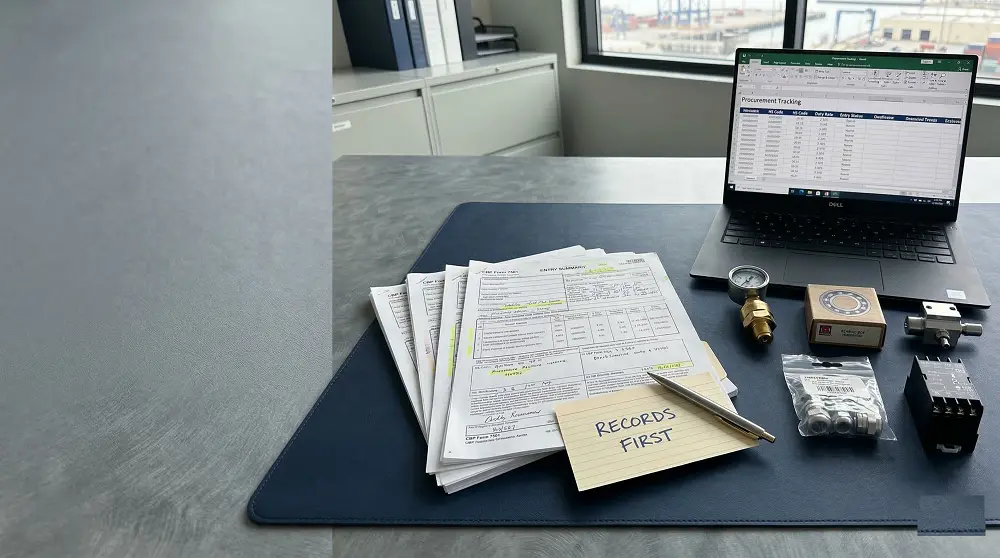
In industrial procurement, the commercial issue is rarely one single customs line. The real problem is file quality. The minute a refund opportunity appears, weak records become expensive. Many importers know they paid extra duty, but they cannot quickly separate which entries were affected, which importer number was used, which broker filed the entry, whether the entry liquidated, whether ACH refund information is ready, or whether the invoice and HTS mapping can survive internal audit.
For industrial goods, that confusion is common because small urgent shipments are often pushed through by operations teams under pressure. A relay spare, bearing kit, valve accessory, enclosure heater, RTD, or field instrument may feel administratively small, yet those shipments create the exact record fragmentation that slows refund recovery.
If the policy is reversed, IEEPA tariff refunds 2026 could provide significant cost recovery for U.S. importers.
The practical position in March 2026
Operationally, the refund process is still a moving target. Recent reporting on court filings says CBP is building an ACE-based process intended to streamline IEEPA refund handling and reduce manual work. Public descriptions of that proposed workflow indicate importer declarations, system validations, aggregate calculation of refunds with interest, and electronic disbursement.
Trade attorneys are advising clients to track all duty payments related to potential IEEPA tariff refunds 2026.
That means industrial importers should not confuse legal change with operational completion. The tariff environment changed. The workflow to recover money is still being built. For a serious buyer, that gap is exactly where preparation matters.
What your team should prepare now
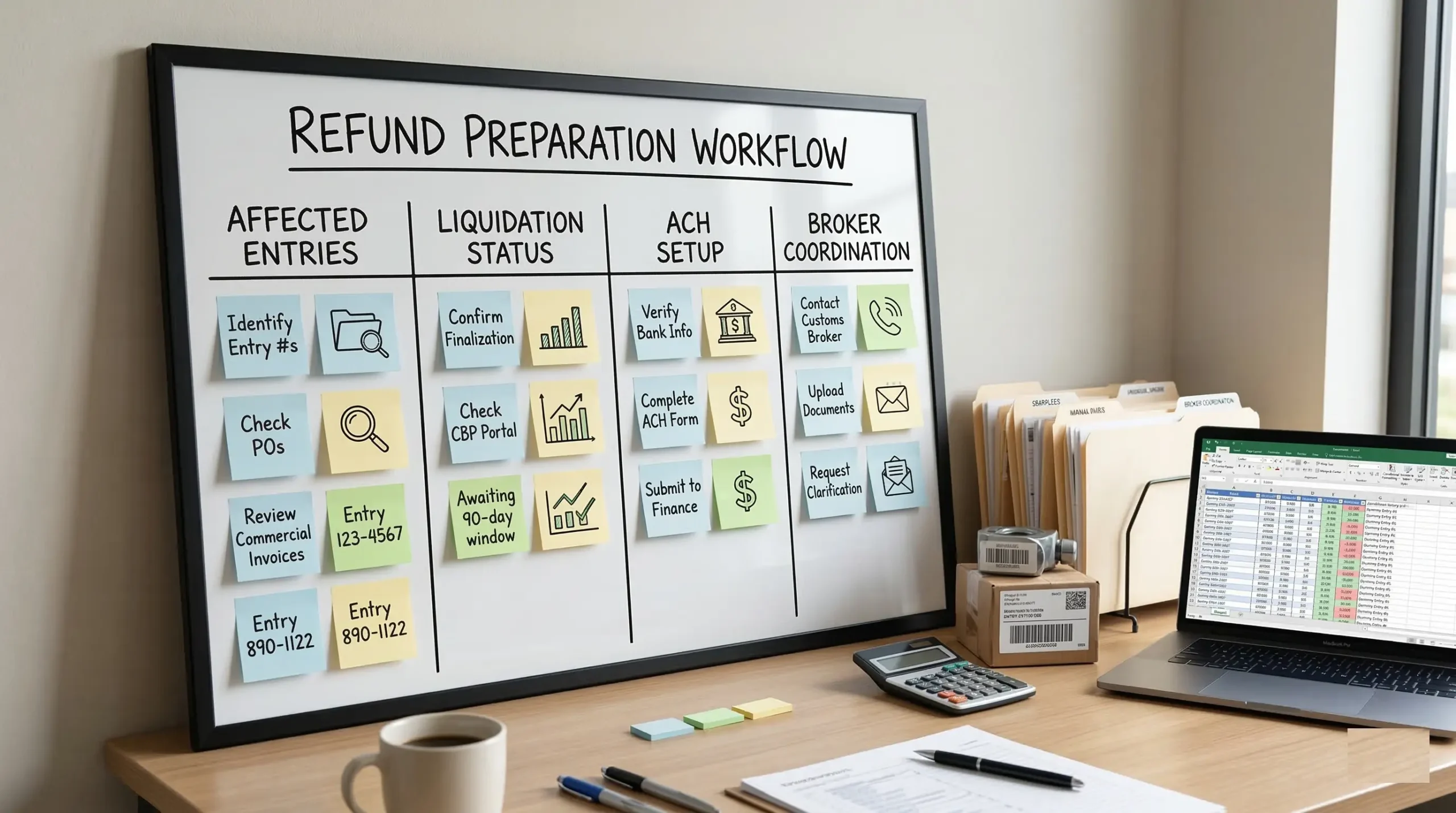
Do not wait for the final button in ACE to appear before cleaning your records. The companies that recover smoothly are usually the ones that prepare a refund file before CBP finishes the interface.
The debate around IEEPA tariff refunds 2026 highlights the uncertainty businesses face under emergency trade powers.
Refund preparation checklist
- Build one master list of potentially affected entries by entry number, entry date, port, broker, importer number, and total IEEPA duties paid.
- Separate entries by liquidation status. Unliquidated and liquidated files do not always behave the same way in customs workflow.
- Pull broker entry summaries, internal duty reports, commercial invoices, packing lists, and proof of payment into one controlled folder.
- Confirm which legal entity was importer of record on each entry. Refund ownership questions become messy when affiliates buy under different numbers.
- Map each entry to the relevant project, plant, customer, or stock transaction so finance and management can understand business impact.
- Verify ACE portal access and confirm who inside the company can view importer data and refund-related banking information.
- Confirm ACH refund readiness and bank data accuracy. Even a valid refund can be delayed if setup and permissions are incomplete.
- Create an internal exceptions log for disputed HTS, incomplete invoices, broker changes, or entries where supporting documents are missing.
PSC, protest, and the mass-refund process are not the same thing
One of the biggest mistakes online is mixing up every customs remedy into one sentence. A post-summary correction is not the same as a protest, and neither is identical to whatever automated IEEPA refund pathway CBP ultimately finalizes.
Some manufacturers are already preparing internal audits to support possible IEEPA tariff refunds 2026 claims.
CBP states that a PSC is the sole electronic method to correct ACE entry summaries before liquidation. CBP also states that PSCs generally must be filed within 300 days from entry and up to 15 days before scheduled liquidation, whichever is earlier. If the entry is already liquidated, CBP explains that liquidation status changes the available path and that a protest is the administrative vehicle within 180 days of liquidation for contesting CBP decisions.
Experts say staying informed about IEEPA tariff refunds 2026 will be critical for importers navigating trade policy changes.
So the right operational view is simple. If your team has ordinary entry-data problems, liquidation status still matters. If a broad automated IEEPA refund process opens, it may handle many entries in parallel. But if a file is unusual, incomplete, or close to a deadline, your broker and trade counsel need to evaluate the correct lane early.
Financial teams may need to revisit landed cost calculations if IEEPA tariff refunds 2026 are approved.
What records usually decide whether a refund file moves fast
Refund projects slow down when the importer has no single ownership model. In practice, the winning file usually has one coordinator and one evidence folder. That folder should tie together entry data, broker reports, internal duty postings, supplier invoice copies, and any internal notes explaining the item and project.
The timeline for IEEPA tariff refunds 2026 will depend heavily on court rulings and administrative guidance.
For industrial clients, I recommend a record package with line-level discipline. If one shipment carried a mixed list of plant consumables and one urgency spare, your team should still know which lines carried the relevant IEEPA burden. Finance will ask for totals. Operations will ask whether new purchase budgets should reflect recovery. Internal audit will ask whether you can prove the refund belongs to the correct importer entity.
The possibility of IEEPA tariff refunds 2026 is prompting companies to review their customs documentation procedures.
IEEPA tariff refunds 2026 – Minimum data fields to capture in your working file
- Entry number and entry summary date
- Importer of record number and importer legal entity
- Broker name and broker contact
- Port of entry
- Country of origin as declared
- HTS classification used on the entry
- Entered value and IEEPA amount paid
- Liquidation status and liquidation date if already liquidated
- Project or plant reference tied to the goods
- Invoice number, supplier name, and item description
- Whether ACH refund setup is confirmed
- Internal owner for follow-up and escalation
ACH and portal readiness
Even before the current IEEPA refund wave, CBP already had ACH refund capability and had modernized ACE portal functions for electronic refund bank information. That is why import teams should verify portal access, importer sub-account rights, and bank data now. A perfect refund entitlement is still operationally weak if the receiving setup is incomplete or controlled by the wrong party.
Import compliance officers are creating documentation systems in anticipation of IEEPA tariff refunds 2026.
If your company uses a broker, do not assume the broker controls every refund instruction automatically. Confirm whether the importer itself, a designated notify party, or another authorized party is set up to receive funds and notices.
Businesses that kept accurate records will be better positioned if IEEPA tariff refunds 2026 become available.
Common mistakes that will slow recovery
- Treating this as only a finance matter and not involving import operations and the customs broker.
- Waiting for CBP’s final workflow before assembling entry records.
- Assuming all trade pain ended when the IEEPA duties ended.
- Mixing entries from multiple importer entities into one uncontrolled spreadsheet.
- Ignoring liquidation status until the last minute.
- Failing to verify ACH refund permissions and bank information.
- Using vague product descriptions that do not help internal audit or plant buyers connect the file back to a real shipment.
Many logistics managers are discussing how IEEPA tariff refunds 2026 might reshape import cost planning.
If refunds move forward, IEEPA tariff refunds 2026 could affect millions of dollars in previously paid duties.
FAQ
No. The February 20, 2026 order ended certain IEEPA tariff refunds 2026 additional ad valorem duties, but the same order says the de minimis suspension and the temporary Section 122 surcharge were unaffected.
No. You should prepare the evidence file now. Waiting wastes time and usually exposes missing entries, missing invoices, and missing access permissions late in the process.
Yes. They still matter for ordinary customs corrections and for files where liquidation status affects the available remedy. That does not mean every IEEPA refund will require the same path, but it does mean your team should understand status early.
Because industrial spares are often urgent, mixed across projects, and bought by teams that care about uptime first. That urgency often creates messy entry files, which then slows refund recovery.
Assign one owner and build one controlled master list of all potentially affected entries. Without ownership and a clean list, every later step becomes slower and more expensive.
Conclusion
For IEEPA tariff refunds 2026, industrial import teams do not need drama here. They need file discipline. The strongest move in March 2026 is not speculation about how much money may come back. The strongest move is to identify every potentially affected entry, assign one owner, verify liquidation status, verify ACH and ACE readiness, align with your broker, and build a clean evidence file before the final CBP workflow is fully live.
After IEEPA tariff refunds 2026, If you do that now, your team will be in a better position to recover money, answer management questions, and avoid last-minute customs confusion on the next urgent shipment.