
How U.S. Power Plant Buyers Avoid Supply Chain Rejection in 2026

How U.S. Power Plant Buyers Avoid Supply Chain Rejection in 2026

If you buy parts for a U.S. combined cycle power plant or a substation project, particularly in light of the Industrial Supply Chain Regulations 2026, you already know one painful truth. Most delays are not because the item is rare.

Most delays happen because the evidence pack is weak.

Understanding the impact of Industrial Supply Chain Regulations 2026 is crucial for efficient operations.

The adherence to the Industrial Supply Chain Regulations 2026 is essential for procurement integrity.

With the Industrial Supply Chain Regulations 2026 in effect, compliance has never been more critical.

Failure to comply with the Industrial Supply Chain Regulations 2026 can lead to significant setbacks.

Workers inspecting package in warehouse.

In 2026, the procurement reality is stricter due to the Industrial Supply Chain Regulations 2026. Buyers are under pressure from internal QA, client auditors, insurers, and federal style expectations even when the buyer is private. One missing test report, one wrong certificate format, one unclear country of origin, and your “good price” becomes a rejected shipment.

This article is written for U.S. procurement managers, plant managers, and EPC package owners who buy mechanical and electrical MRO items for CCPP and substations. The goal is simple. Reduce rejection risk before PO, not after cargo is shipped, especially considering the Industrial Supply Chain Regulations 2026.

Navigating the Industrial Supply Chain Regulations 2026 requires expertise and diligence.

You will get a clean 10 point checklist, plus a practical document pack structure you can copy into your RFQ process.

Key changes under the Industrial Supply Chain Regulations 2026 will shape future procurement strategies.

Table of Contents

Understanding the Importance of Industrial Supply Chain Regulations 2026

  1. What changed in 2026 procurement reality for power projects
  2. The 10 silent rejection triggers buyers keep repeating
  3. A simple pre award document pack that stops surprises
  4. Item list, 20 common CCPP and substation MRO items with evidence needs
  5. How to validate OEM and stop cross border fraud
  6. Certificates, what is valid, what is useless, what is dangerous
  7. Traceability, the real meaning, not the marketing word
  8. Packing, labeling, and logistics mistakes that create compliance failure
  9. How to write an RFQ that forces vendors to be honest
  10. A one page acceptance decision method you can forward internally
    FAQ
  11. What changed in 2026 procurement reality for power projects

Many teams still buy using an old mindset. Find vendor, get quote, place PO, collect documents later.

That method worked when schedules were loose and audits were soft. Now the risk is different.

Today rejection risk is driven by five forces.

First, supply chain risk controls are tighter. Buyers want to avoid restricted origin, hidden subcontracting, and unknown factories. Even when not federal, these rules appear through client contract flow down.

The impact of the Industrial Supply Chain Regulations 2026 cannot be overlooked.

The implications of the Industrial Supply Chain Regulations 2026 will affect all stages of procurement.

Second, paperwork must match the exact project requirement. Not “similar”, not “equivalent”. The document must match the specific standard, revision, and scope.

Third, counterfeit risk is more professional. Fraud is not only fake items. It is also real items with fake papers, or genuine papers reused from another batch.

Fourth, traceability expectations are rising. It is not enough to show a certificate. The certificate must connect to the item serial, heat number, lot number, and the invoice line.

Fifth, internal procurement teams are under speed pressure. When speed increases, mistakes increase. That is why you need a fixed system.

Vendors must adapt to the Industrial Supply Chain Regulations 2026 for successful collaboration.

If you want fewer rejections, you need a pre award evidence method. It is cheaper, faster, and safer than chasing documents after PO.

  1. The 10 silent rejection triggers buyers keep repeating

The evolving nature of the Industrial Supply Chain Regulations 2026 demands adaptability.

Below are the most common rejection triggers I see in power plant and substation procurement. These are “silent” because they look small, but they kill approvals.

2.1 Wrong certificate type
A vendor sends “CE certificate” but it is only a self declaration, or it is for a different model. Or it is a marketing brochure.

2.2 Test report not linked to serial or lot
A routine test report looks professional, but it has no serial list, no lot reference, no trace to your shipment.

Staying informed about the Industrial Supply Chain Regulations 2026 can provide a competitive edge.

2.3 Country of origin confusion
Invoice says one country, packing list implies another, manufacturer address shows a third. This becomes a hold.

2.4 Manufacturer name mismatch
RFQ says “Brand X”. Vendor quotes “Brand X equivalent”. Buyer assumes it is the same. After PO, vendor ships a different manufacturer.

2.5 Part number control missing
Many rejections happen because one digit changed. A vendor shows a similar part number but not the exact spec variant.

2.6 EN 10204 misuse
A vendor sends 3.1 for an item that needs 3.2 under project rules, or sends a generic 3.1 without heat number.

2.7 Hazardous area evidence missing
ATEX, IECEx, UL Class Division, sometimes required for adjacent systems, not only for obvious instruments. Teams miss this often.

The Industrial Supply Chain Regulations 2026 mandate stricter documentation and compliance checks.

2.8 Calibration and certification gap
Gauges, transmitters, analyzers, torque tools. Vendor sends “calibration certificate” that is not traceable, or not from an accredited lab, or has no serial.

2.9 Subcontracting hidden
Vendor claims “OEM direct”, but actually buys from an unknown broker. The proof pack collapses when audited.

2.10 Packing and labeling failure
No serial marking, no case ID mapping, mixed lots in one box. Even if items are correct, the receiving team cannot verify, so they reject.

If you fix these 10, you cut rejection risk heavily. Not by motivation, by evidence.

Knowledge of the Industrial Supply Chain Regulations 2026 can differentiate successful vendors.

  1. A simple pre award document pack that stops surprises

Here is a clean pack structure you can demand before award. This is the method most teams skip, and then they pay the price later.

Pre Award Pack, minimum
A. Supplier identity and authorization
• Company registration proof
• Physical address proof
• Authorized distributor letter (if not OEM direct)
• Website and domain match evidence
• Bank account name match with company name

Understanding the nuances of the Industrial Supply Chain Regulations 2026 is essential for procurement teams.

B. Item identity and configuration
• Exact part number and revision
• Data sheet with key parameters highlighted
• Drawing or dimensional sheet when needed
• Nameplate sample photo for the same model family

C. Compliance and standards evidence
• Standard statement, example: UL, CE, ATEX, IECEx, ISO, API, ASME, NEMA
• Certificate copy with scope and model list
• Declaration of conformity if applicable
• Any project specific compliance statement

D. Traceability and quality evidence
• Sample routine test report format
• Sample serial or lot list format
• Material certificate format if metal critical
• ITP outline or inspection points (simple list is enough)

The Industrial Supply Chain Regulations 2026 are pivotal in shaping future supplier relationships.

E. Shipping and packaging evidence
• Packing method description
• Labeling method for serial, lot, case ID
• Country of origin statement format
• HS code suggestion (buyer must confirm final)

Stakeholders must align with the Industrial Supply Chain Regulations 2026 to ensure compliance at all levels.

Many vendors will say “we provide after PO”. That is a trap. After PO, leverage drops. If they cannot show sample formats before award, you should treat it as risk.

This pack does not slow you. It speeds you up because it prevents later chaos.

The Industrial Supply Chain Regulations 2026 require transparency throughout the supply chain.

  1. Item list, 20 common CCPP and substation MRO items with evidence needs

Below are 20 common items used in dual fuel CCPP and substation support scope. These are not turbines, not big packages. These are the items where paperwork mistakes happen most.

For each item, focus on the evidence type, not only the price.

4.1 Bearings
Key risks: counterfeit, wrong part number, mixed origin
Evidence: authorized distributor proof, OEM traceability, batch or lot mapping
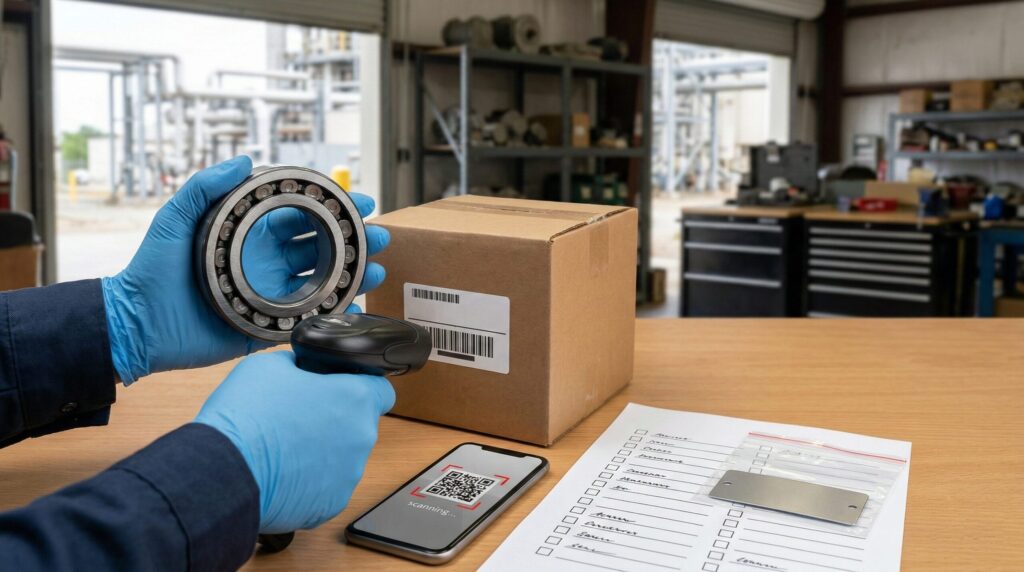
Person scanning barcode near equipment

4.2 Mechanical seals
Key risks: wrong materials, wrong seal face, wrong elastomer
Evidence: configuration sheet, material statement, part number mapping

4.3 Industrial hoses and fittings, hydraulic
Key risks: pressure rating mismatch, incompatible fluid, wrong thread standard
Evidence: pressure test standard statement, datasheet, lot trace method

4.4 Valves, ball, gate, globe
Key risks: body material mismatch, pressure class mismatch, trim mismatch
Evidence: MTR format if required, pressure rating proof, nameplate sample

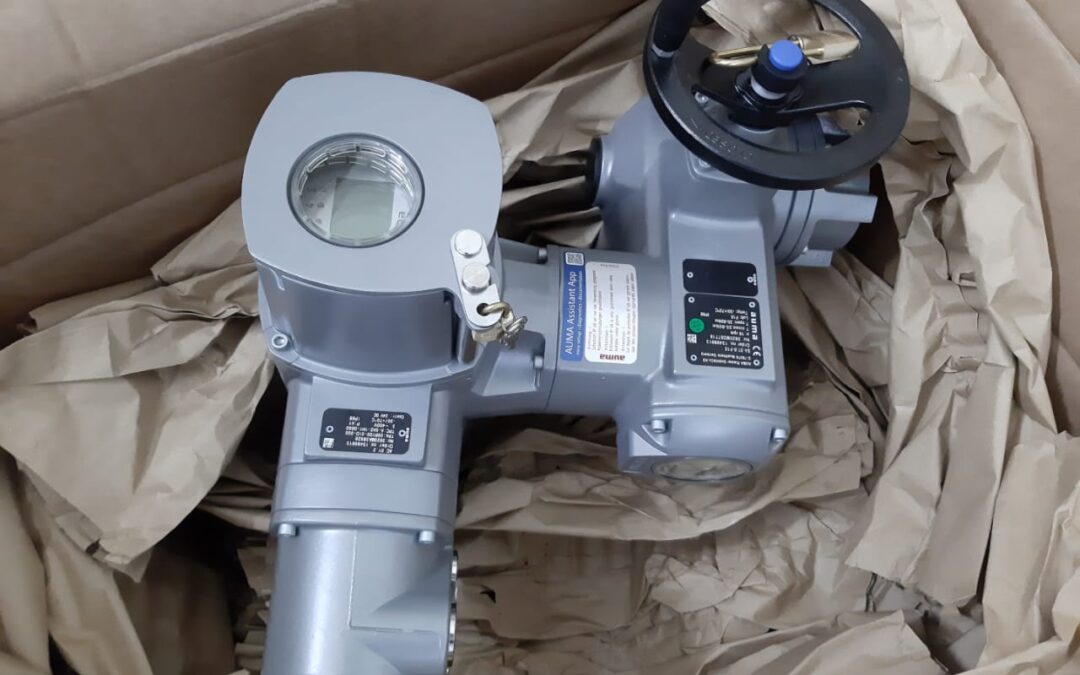
4.5 Control valves and actuators small sizes
Key risks: wrong fail position, wrong air supply, wrong positioner spec
Evidence: datasheet with highlighted values, calibration evidence, model list

4.6 Pressure gauges
Key risks: calibration not traceable, wrong range, wrong accuracy class
Evidence: calibration certificate with serial, lab trace info, model sheet

Awareness of the Industrial Supply Chain Regulations 2026 is crucial for all stakeholders.

Ensuring compliance with the Industrial Supply Chain Regulations 2026 requires diligence.

4.7 Pressure transmitters
Key risks: hazardous area rating missing, wrong protocol, wrong range
Evidence: certificate scope, calibration with serial, datasheet

4.8 Temperature sensors, RTD, thermocouple
Key risks: wrong sheath material, wrong length, wrong class
Evidence: spec sheet, material statement, test format

With changes from the Industrial Supply Chain Regulations 2026, clarity in documentation is paramount.

4.9 Flow meters small and medium
Key risks: wrong accuracy, wrong wetted materials, wrong approvals
Evidence: certificate scope, calibration statement, datasheet

Integrating the Industrial Supply Chain Regulations 2026 into your strategy is imperative for success.

4.10 Gas detector sensors
Key risks: wrong gas type, wrong certification, expired sensor
Evidence: ATEX or UL scope evidence, shelf life statement, test format

4.11 Electrical cable glands and junction boxes
Key risks: hazardous area mismatch, wrong ingress rating, non compliant alloy
Evidence: ATEX or IECEx scope, IP rating proof, model list

4.12 Circuit breakers and protection accessories
Key risks: counterfeit, wrong interrupt rating, wrong series
Evidence: manufacturer authorization, datasheet, batch trace

4.13 Relays and contactors
Key risks: wrong coil voltage, wrong approvals, mixed stock
Evidence: datasheet, origin statement, lot trace

4.14 Industrial power supplies for control panels
Key risks: wrong approvals, wrong EMC compliance, overheating
Evidence: UL listing scope, datasheet, test format

4.15 Pumps small auxiliary pumps
Key risks: efficiency requirements, wrong materials, seal failures
Evidence: pump curve, motor data, compliance statement, serial list format

4.16 Filters and strainers
Key risks: wrong micron rating, wrong materials, no trace
Evidence: spec sheet, lot mapping, origin statement

4.17 Gaskets and packing
Key risks: wrong compound, wrong temperature limit, asbestos risk
Evidence: material statement, compliance statement, batch trace

4.18 Industrial lubricants and chemicals
Key risks: restricted shipping, wrong SDS, mismatch with equipment
Evidence: SDS, COA format, shipping classification

4.19 Torque tools, hydraulic torque wrench accessories
Key risks: calibration missing, wrong drive size, unsafe use
Evidence: calibration certificate with serial, instruction manual, origin

The Industrial Supply Chain Regulations 2026 are reshaping the landscape for procurement professionals.

4.20 Thermal imaging camera accessories and batteries
Key risks: warranty issues, origin restrictions, wrong model
Evidence: manufacturer authorization, serial list, warranty statement

Proactive measures regarding the Industrial Supply Chain Regulations 2026 can mitigate risks.

If you want a strong system, you do not treat these as “small items”. In the USA, paperwork is part of the product.

Fostering a culture of compliance with the Industrial Supply Chain Regulations 2026 is critical.

  1. How to validate OEM and stop cross border fraud

Most buyers think OEM verification means one email.

In reality, OEM verification is a chain.

Here is a practical approach that works.

With the Industrial Supply Chain Regulations 2026, compliance is not just a suggestion.

Understanding implications of the Industrial Supply Chain Regulations 2026 is vital for market success.

Step 1, identity match
Verify that supplier legal name, address, and bank account name are consistent. Fraud often shows mismatch.

Step 2, authorization proof
If supplier is not OEM direct, demand an authorized distributor letter. If they cannot provide, treat as broker risk.

Step 3, item mapping
Ask for a line by line mapping table:
• your RFQ line item
• quoted manufacturer
• exact part number
• country of manufacture
• lead time basis
This table must be signed and stamped.

Step 4, serial or lot control promise
Even before shipment, vendor must confirm how serials or lots will be listed. If vendor says “we do not track serials”, you already know the receiving team will struggle.

Step 5, evidence index
Demand an evidence index list that names every document file that will be delivered. Example:
• Certificate file name
• Test report file name
• Packing list file name
• COO statement file name
This becomes your audit map.

This is not “extra work”. This is preventing disaster.

  1. Certificates, what is valid, what is useless, what is dangerous

In power procurement, certificates are the biggest lie zone. Not because all vendors are bad, but because many do not understand what buyers need.

Here is a clear way to think.

Valid certificates usually have
• issuing body name
• scope and product family
• model list or reference
• date and validity rules
• traceable identifier

Useless documents often look nice but contain
• no scope
• no model list
• marketing language only
• “certificate of quality” with no standard reference

Dangerous documents are worse than useless. They can create legal exposure. Examples
• copied certificate with altered dates
• certificate issued to a different company
• test report for a different batch reused

Your safe approach is simple. Do not accept a certificate alone. Always connect it to
• item model
• item serial or lot
• supplier authorization chain
• project standard requirement

When a team says “vendor will provide later”, that is a red flag. Evidence is not optional. It is part of the deliverable.

  1. Traceability, the real meaning, not the marketing word

Many vendors say “full traceability”.

But traceability has levels.

Failure to adhere to the Industrial Supply Chain Regulations 2026 can result in serious consequences.

Level 1, paperwork trace only
Invoice and packing list exist. No serial or lot link. This is weak.

Level 2, lot trace
Vendor provides lot number list, and each box label shows lot. Good for many consumables.

Level 3, serial trace
Each unit has a serial, and the serial list maps to test report. Strong for instruments, torque tools, electronics.

Level 4, material heat trace
For critical metal items, heat number links to MTR and to part marking. This is high control.

For most CCPP and substation MRO, you want at least Level 2, and for instruments you want Level 3.

The Industrial Supply Chain Regulations 2026 will be a focal point in future audits.

A simple traceability matrix table can stop many rejections. Example columns
• RFQ line
• PO line
• part number
• serial or lot
• packing case ID
• test report ID
• certificate ID
• receiving inspection result

If your vendor cannot support this table, your risk is high, even if price is low.

  1. Packing, labeling, and logistics mistakes that create compliance failure

Many teams focus on documents, but forget packaging.

Receiving teams need fast verification. If packaging is messy, they cannot verify and approvals stop.

Common failures
• mixed models in one box without separation
• no case ID marking
• serial labels missing or rubbed off
• packing list not showing case level contents
• COO statement not matching carton markings

Effective strategies must incorporate the Industrial Supply Chain Regulations 2026 for optimal results.

A simple fix is to require these rules
• each case has a unique case ID
• packing list includes case ID and contents
• serial or lot list references case ID
• photos of packed cases before dispatch

This is not for beauty. It reduces receiving time and avoids dispute.

  1. How to write an RFQ that forces vendors to be honest

A strong RFQ is not long. It is specific.

Here is a structure you can reuse.

RFQ Section A, scope and acceptance
• item list, exact part numbers
• acceptable manufacturers, and whether alternates allowed
• required standards and certificates
• required traceability level
• required pre award sample formats
• delivery terms and packaging rules

RFQ Section B, vendor declarations
Ask vendor to confirm, in writing
• manufacturer name and country of manufacture
• whether supplier is OEM, authorized, or broker
• whether documents are available before shipment
• whether serial or lot list will be provided

RFQ Section C, rejection conditions
Write clear rejection conditions, example
• mismatch of part number or manufacturer
• missing evidence pack items
• certificate scope mismatch
• traceability list missing
• country of origin inconsistency

When rejection conditions are written clearly, good vendors become more serious, and risky vendors leave early. That is what you want.

Strategizing around the Industrial Supply Chain Regulations 2026 can yield significant advantages.

  1. A one page acceptance decision method you can forward internally

Many approvals get stuck because stakeholders argue emotionally.

Use a one page decision method.

One Page Risk Summary

  1. Item group: mechanical, electrical, instrumentation
  2. Supplier type: OEM, authorized, broker
  3. Evidence status: complete, partial, missing
  4. Traceability level: 1 to 4
  5. Compliance match: exact, unclear, mismatch
  6. Risk rating: green, amber, red
  7. Recommendation: proceed, proceed with conditions, hold, stop
  8. Next actions with owner and date

This is what internal teams like. It is short, decision focused, and audit friendly.

FAQ

Q1. Why do good priced items still get rejected in the USA?
Because in the USA, compliance and traceability are treated as part of the product. If evidence does not match the requirement, the buyer cannot approve.

Q2. Do I always need OEM direct sourcing?
Not always. But you must prove the authorization chain and keep traceability strong. Authorized distributor sourcing can be safe when evidence is clean.

Compliance with the Industrial Supply Chain Regulations 2026 is a non-negotiable aspect of procurement.

Adapting to the Industrial Supply Chain Regulations 2026 will ensure smoother operations.

Q3. What is the fastest way to reduce rejection risk?
Demand pre award sample formats for certificates, test reports, serial list, and origin statement. If vendor cannot show formats before award, risk is high.

Q4. What is the biggest mistake procurement teams make?
They accept “documents after PO” as normal. After PO, leverage is low and the project schedule becomes hostage.

For assistance navigating the Industrial Supply Chain Regulations 2026, reach out to industry experts.

Q5. Can small items like gauges and fittings create major compliance problems?
Yes. Small items often have the highest document error rate, especially calibration, hazardous area approvals, and origin confusion.

Call to Action

If your team is losing time due to vendor document gaps, cross border fraud risk, or repeated receiving rejections, I can support with a pre award evidence review and a clean risk summary your team can forward internally.

Email: contact@shafiqulmowla.com
WhatsApp: +8801748778853
Website: www.shafiqulmowla.com

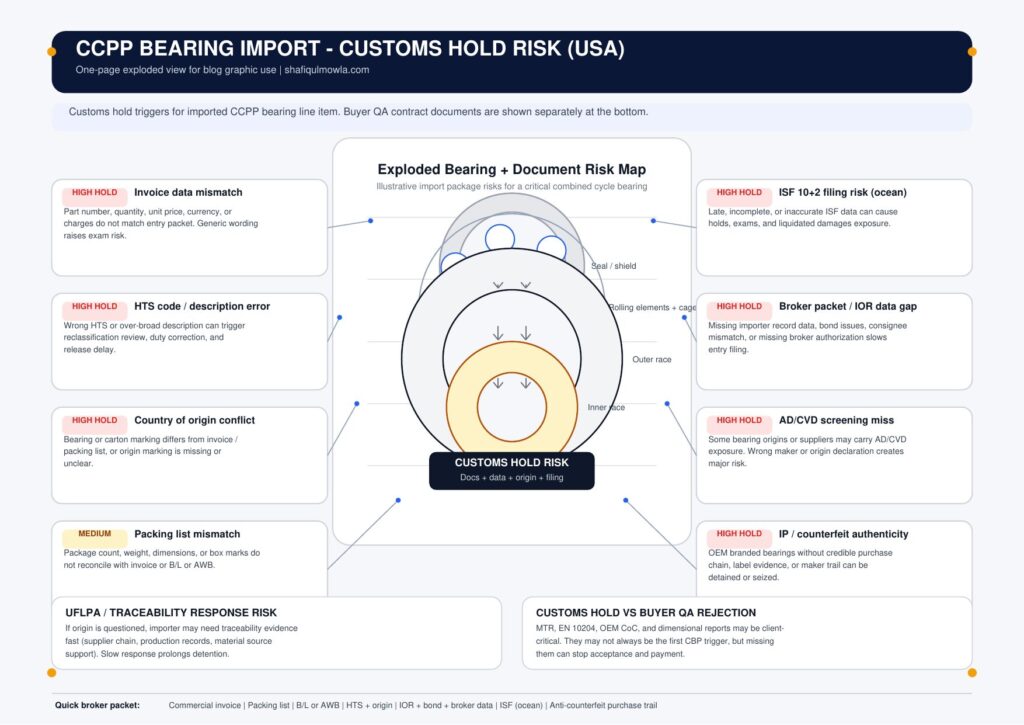
CCPP Bearing Import to USA: Document Risks That Can Cause Customs Hold

CCPP Bearing Import to USA: Document Risks That Can Cause Customs Hold

A Combined Cycle Power Plant bearing is not only a mechanical spare.

For U.S. import entry, it is a document-sensitive item. Many shipments are delayed not because the bearing is fake, but because the paperwork is incomplete, inconsistent, or poorly matched.

If one document says one thing and another document says something else, customs review can slow down. For urgent plant maintenance or shutdown work, even a short delay can create serious commercial loss.

Why a bearing shipment gets held

Customs hold risk usually starts from mismatch in the document chain. A CCPP bearing shipment normally depends on these papers:

  1. Commercial Invoice
  2. Packing List
  3. Bill of Lading / Air Waybill
  4. Purchase Order or Order Confirmation
  5. Certificate of Conformity (if supplied)
  6. Material Certificate / Test Certificate (if claimed)
  7. Country of Origin statement and marking
  8. Broker filing data (classification, value, importer details)

When these papers do not match line by line, customs or broker review becomes difficult.

Main document risks for CCPP bearing imports

1) Generic product description

If the invoice says only “bearing spare” or “machine bearing,” this is weak. A CCPP bearing should have a proper commercial description.

Example problems:

  • unclear use
  • unclear type
  • unclear specification
  • wrong tariff classification risk

Better practice is to describe the item clearly with model, type, and industrial use.

2) Part number mismatch

This is one of the biggest risks. The part number on invoice, packing list, and certificate must match exactly.
Even one missing digit, wrong suffix, or revision mismatch can create:

  • entry delay
  • broker query
  • internal compliance stop
  • buyer rejection risk

3) Country of origin confusion

Many people confuse country of shipment with country of origin. They are not always the same.
If origin marking on box says one country but invoice says another, customs review risk increases.
Problems can happen when:

  • origin statement is missing
  • product marking is absent
  • carton label and invoice origin do not match

4) Incorrect value declaration

If a high-value industrial bearing is declared at a suspiciously low value, it can attract attention.
Also risky:

  • no unit price
  • no total line value
  • unclear freight separation
  • wrong currency mention
  • inconsistent invoice and purchase order values

This creates valuation questions and can slow release.

5) Certificate claims but no support

Sometimes seller writes “OEM,” “original,” or “certified” in quotation or invoice, but shipment file has no matching certificate.
This creates risk for importer and consultant because:

  • declared quality cannot be proven quickly
  • buyer approval may stop
  • customs exam time becomes more dangerous due to weak file

6) Packing list mismatch

Packing list is often ignored, but it is very important.
Common mistakes:

  • wrong quantity
  • wrong net/gross weight
  • missing crate numbers
  • no dimensions
  • packing list not matching invoice line sequence

If customs opens cargo and physical packaging does not match packing list, delay risk increases.

7) Wood pallet or crate compliance issue

Even if the bearing documents are correct, the shipment can still be held because of packing material.
Common risk points:

  • untreated wood pallet
  • missing treatment mark
  • damaged or unclear mark
  • mixed packing materials without clear identification

This is a hidden risk in industrial shipments.

8) Importer and consignee data mistakes

Wrong importer name, consignee address, or broker details can create filing problems.
Common errors:

  • old company address used
  • wrong contact person
  • inconsistent consignee name spelling
  • importer tax data mismatch in filing records

These are coordination mistakes, but they can still delay customs release.

What customs hold means in business reality

A customs hold does not always mean seizure. In many cases it means delay for review, inspection, clarification, or additional information. But for a power plant spare, delay itself is a major cost.

Possible business impact:

  • outage schedule disruption
  • emergency expediting cost
  • storage or demurrage risk
  • internal blame between vendor, buyer, broker, and forwarder
  • loss of confidence in consultant or supplier

Simple prevention checklist before shipment

For each critical bearing shipment, verify these points before dispatch:

  • Exact part number and revision matches all documents
  • Clear item description on invoice and packing list
  • Quantity and unit match everywhere
  • Country of origin is correctly stated and marked
  • Invoice value and currency are accurate
  • Certificate list matches what seller promised
  • Packing list weight and dimensions are correct
  • Crate / pallet compliance is checked
  • Importer, consignee, and broker details are correct
  • Final pre-shipment document review is completed line by line

Final note

For CCPP bearing imports, customs clearance depends heavily on document quality. The bearing may be genuine and urgent, but weak paperwork can still stop movement.

Good import control starts before shipping, not after the cargo reaches the port.

Alcad NiCd Batteries for US Power Plants: Why Engineers Still Trust Pocket‑Plate NiCd

Alcad NiCd Batteries for US Power Plants: Why Engineers Still Trust Pocket‑Plate NiCd

What really happens inside compliance teams – and how to keep your shipment away from the rejection pile.

1. Why DC battery banks are non‑negotiable in US power plants

Every combined cycle power plant and substation in the US hides one quiet hero: the DC battery bank.
When the grid fails or a black‑start is needed, those batteries keep switchgear, control systems, relays, and emergency lighting alive long enough to shut down safely or restart the plant.

For this job, most utilities are not looking for the “latest hype battery”. They want technology that:

  • Survives 20+ years of real‑world abuse.
  • Works in hot, dusty battery rooms and harsh outdoor enclosures.
  • Delivers reliable power after long float charging and rare deep discharges.

This is exactly where Alcad NiCd batteries still hold a strong position against lead‑acid and many newer chemistries.


2. What makes an Alcad NiCd battery different?

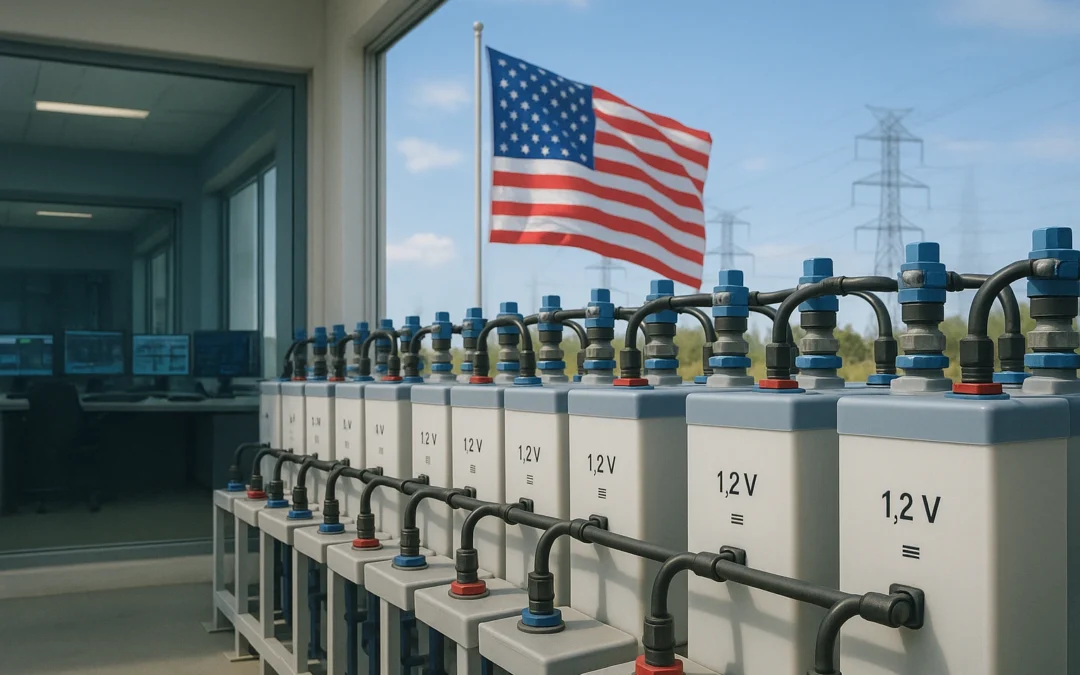
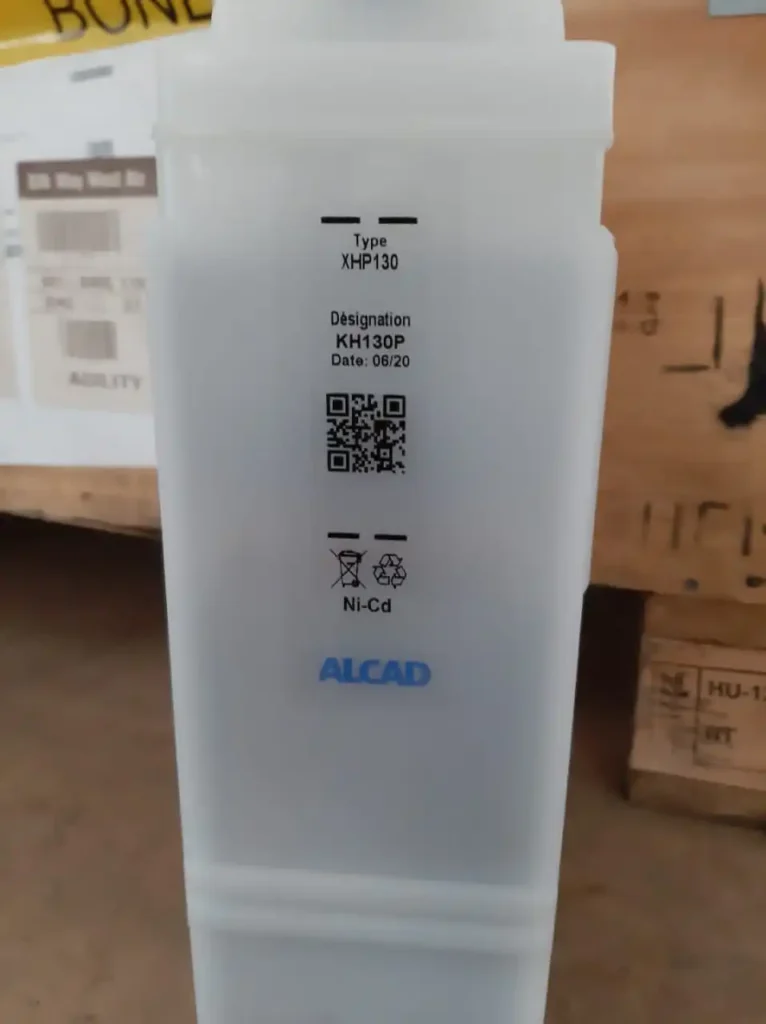
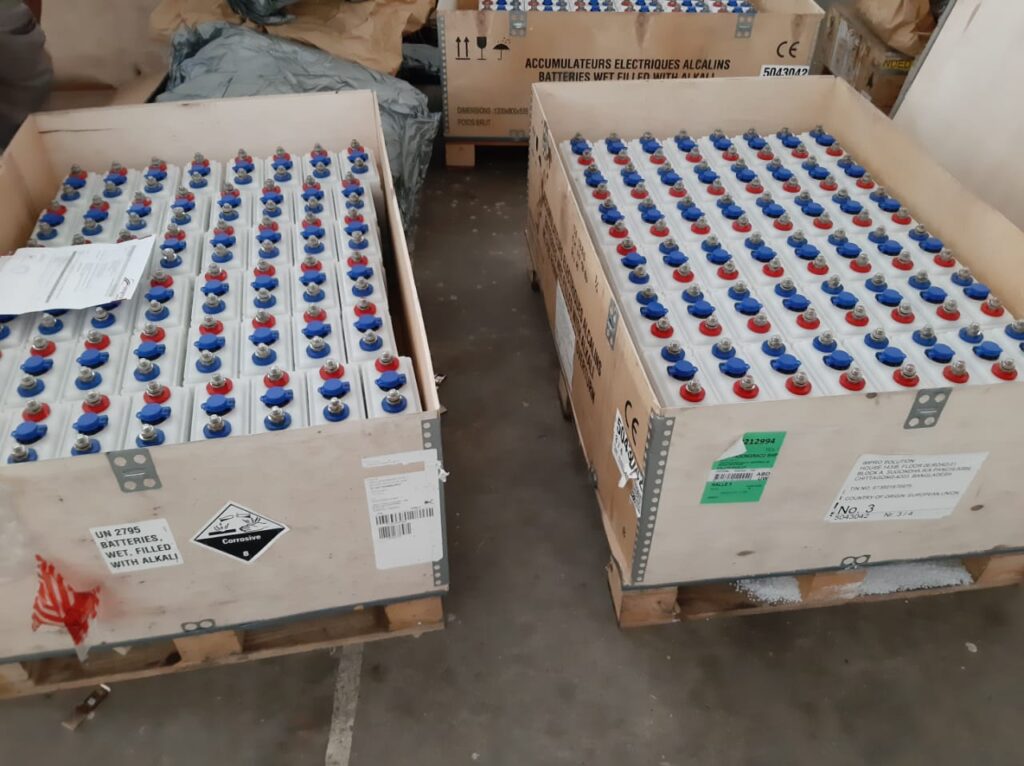
An Alcad nickel cadmium industrial battery is a flooded, pocket‑plate NiCd cell, normally 1.2 V per cell, built for stationary backup.
Instead of fragile plates, it uses welded steel pockets filled with active material and an alkaline electrolyte.
The result is a cell that tolerates abuse, deep discharge, and high temperatures much better than most lead‑acid designs.

For US plants, that means:

  • Very long service life – often 20 years or more with proper maintenance.
  • Wide temperature range – stable performance from cold outdoor yards to hot battery rooms.
  • Low maintenance – top‑up water only a few times per year on a well‑designed system.

That is why you still see Alcad batteries for power plants, substations, and oil & gas facilities worldwide.wer.


3. Typical Alcad ranges used in utility applications

US utilities and EPC contractors normally meet the brand under specific product families:

  • Vantex – a low‑maintenance flooded range popular for substation battery backup, control and protection circuits, and SCADA.
  • XHP – high‑performance starting batteries for generator starting NiCd battery duties and fast discharge loads.
  • LCE and Slim – flexible ranges for UPS, switchgear, and telecom/auxiliary systems where footprint is tight.

You will see these cells built into DC systems for:

  • Gas and steam turbine control power.
  • Substation switchgear and relay protection.
  • Black‑start diesel generators and emergency lube‑oil pumps.
  • NiCd battery for UPS feeding DCS, safety PLCs, and communication systems.

When a federal tender talks about a pocket‑plate NiCd flooded cell or mentions 1.2V 80Ah Alcad battery or 1.2V 285Ah Alcad battery, it is usually one of these families.


4. Key advantages vs industrial lead‑acid

If you are a US plant engineer or MRO manager comparing NiCd vs lead acid industrial solutions, the real question is not only price. It is total risk and lifecycle cost.

4.1 Reliability in harsh environments

Alcad NiCd cells handle:

  • High temperatures without the same rapid capacity loss seen in VRLA lead‑acid.
  • Deep discharge and abuse, such as long cranking of emergency diesels.
  • Mechanical shocks and vibration found in turbine halls and outdoor yards.

For remote, unmanned sites – pipelines, compressor stations, renewable‑connected substations – this robustness is a major reason to choose industrial NiCd battery supplier over a cheaper VRLA rack.

4.2 Life‑cycle cost and TCO

Capex for an Alcad battery bank is higher than a standard lead‑acid system.
However, when you calculate Alcad battery TCO (Total Cost of Ownership) over 20+ years, the picture changes:

  • Fewer full replacements.
  • Less emergency call‑out due to sulfation or premature capacity loss.
  • Lower risk of nuisance trips, lost megawatt hours, and regulatory penalties.

Long‑term, many utilities find Alcad battery service life cheaper than multiple cycles of lead‑acid change‑outs.

4.3 Safety and environmental stability

NiCd cells are non‑flammable, with tough steel cases and flame‑retardant containers.
They are very resistant to thermal runaway, a key concern for some high‑energy chemistries.
Cadmium is hazardous, but controlled recycling channels exist, and federal contracts typically require proof of compliant disposal.


5. Where your US tender language usually hides the NiCd rules

Federal and utility buyers in the USA rarely say “buy from this brand”.
Instead, they specify standards and performance that naturally point toward Alcad NiCd battery or an equivalent pocket‑plate design.

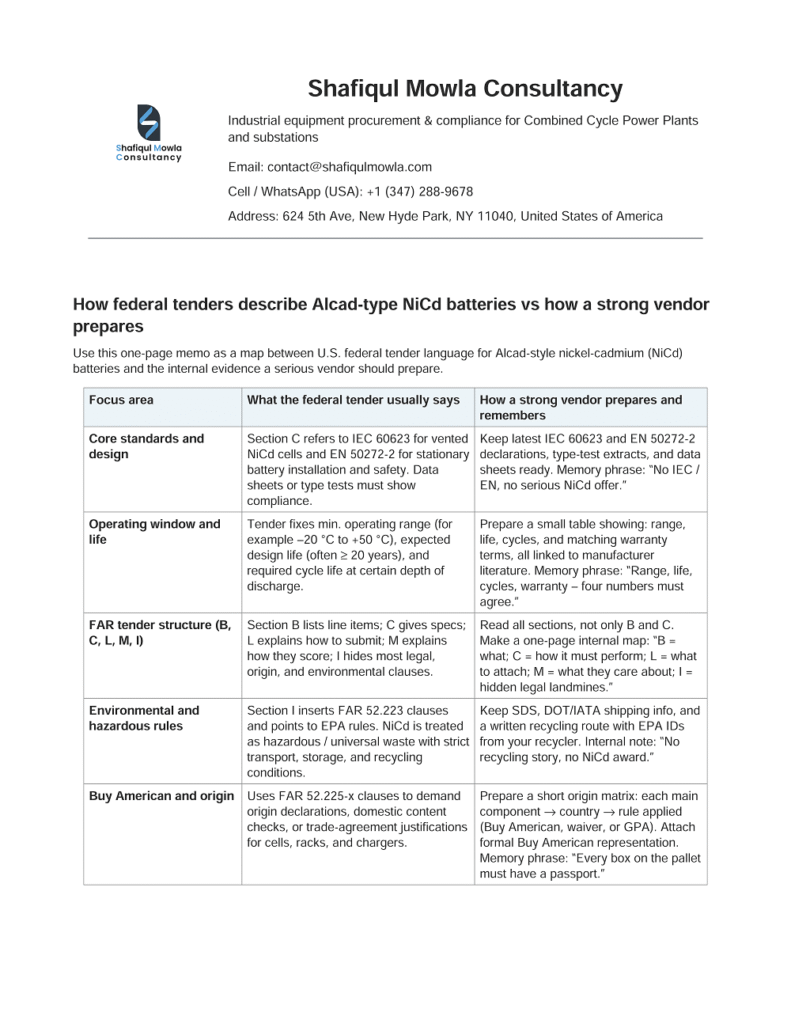
In a typical combined‑cycle or substation tender you will see:

  • IEC 60623 – vented NiCd cell design and performance.
  • EN 50272‑2 / IEEE battery installation standards – safety distances, ventilation, and protection.
  • Requirements for industrial battery harsh environment performance, such as high cycling or extreme temperatures.
  • Exact DC bus voltage, duty cycle, autonomy time, and minimum end‑of‑life capacity.

If you can prove that your Alcad battery specifications meet or exceed these points, you are usually on safe ground technically.


6. Documentation federal buyers expect from an Alcad supplier

When you respond to a US federal or utility RFQ, documentation often decides who wins.
Beyond price, evaluators look for suppliers who make the compliance officer’s life easy.

6.1 Technical and quality documents

Be ready to submit:

  • Detailed Alcad battery data sheet for each cell type and capacity.
  • Type test reports and routine factory test certificates.
  • ISO 9001 and environmental certifications for the manufacturing plant.
  • NiCd flooded cell battery maintenance manual and installation guide.

6.2 Safety and environmental paperwork

For NiCd chemistry, the buyer will ask for:

  • Safety Data Sheets (SDS) covering electrolyte and cadmium.
  • Description of your Alcad battery safety measures – ventilation, PPE, spill trays, eye‑wash.
  • Recycling or Alcad battery refurbishment options and proof of compliant hazardous‑waste handling in the US.

6.3 Project‑specific compliance

Federal‑funded projects may also require:

  • Country‑of‑origin declaration to satisfy Buy American or related rules.
  • Evidence that your industrial battery suppliers USA chain is free from restricted entities.
  • A clear plan for Alcad battery maintenance, testing, and spare parts over the full contract term.

When this bundle is neat and complete, your bid looks like a low‑risk, high‑control option.


7. How to pick the right Alcad battery distributor in the USA

Many vendors can resell batteries. Fewer can support a power plant for 20+ years.

When you evaluate an Alcad battery reseller USA or Alcad battery distributor, look for:

  1. Direct technical link to the OEM – access to factory engineering, firmware bulletins, and testing tools.
  2. Field experience in utilities – real projects in CCPP, substations, or oil & gas, not only telecom racks.
  3. Own team or partners for Alcad battery installation, capacity testing, refurbishing, and troubleshooting.
  4. Ability to hold stock of critical spares and cells for fast Alcad battery replacement in emergency outages.
  5. Capability to package NiCd battery MRO services with training, periodic test plans, and report templates.

In short, choose a partner who helps you run the asset, not just one who ships pallets.


8. RFQ checklist for US plant engineers

Here is a practical list you can adapt into your next specification for Alcad batteries USA or equivalent NiCd solutions:

  1. Application definition
    • DC system voltage, autonomy time, duty cycle, and critical loads.
    • Whether it is battery for mission critical applications (black‑start, protection, or safety systems).
  2. Technology choice
    • Pocket‑plate flooded NiCd battery high temperature capable.
    • Minimum design life (for example, 20 years at specified temperature profile).
    • Target range: Alcad Vantex battery, Alcad XHP battery, Alcad Slim battery, Alcad LCE battery, or equal.
  3. Performance and testing
    • Full duty‑cycle sizing calculations.
    • Factory tests, site acceptance tests, and periodic capacity test requirements for Alcad battery testing.
    • Acceptance criteria for voltage regulation, recharge time, and Alcad battery voltage regulation limits.
  4. Installation and maintenance
    • Rack layout, room ventilation, and seismic anchoring.
    • Detailed plan for watering, visual inspections, torque checks, and NiCd battery low maintenance expectations.
    • Required tools and test equipment for Alcad battery troubleshooting.
  5. Lifecycle and commercial terms
    • Warranty period matched to expected Alcad battery service life.
    • Options for Alcad battery refurbishment near end of life.
    • Long‑term service agreement for Alcad battery maintenance and periodic site visits.

This kind of RFQ immediately signals to the market that you know what you are doing – and filters out weak vendors.


9. Talking to US clients about NiCd in simple language

Many non‑technical stakeholders only see one line item: “battery bank – expensive”.
Your job is to translate NiCd advantages into business outcomes.

When you describe an Alcad battery solution for utilities, focus on points like:

  • Grid reliability – fewer nuisance trips and blackouts due to DC failures.
  • Regulatory comfort – clear documentation for auditors and safety inspectors.
  • Predictable Opex – one long‑life reliable industrial battery instead of repeated emergency replacements.
  • Resilience for remote locationsNiCd battery for remote locations where site access is seasonal or difficult.

Once decision‑makers see NiCd not as a commodity but as a risk‑control tool, budget conversations become easier.


10. Final takeaway for US power plant and substation teams

If you operate a US combined‑cycle plant, substation, or oil & gas facility, your DC system is the last place to experiment.
You need a chemistry and a partner that will still be there when today’s turbine has already seen its first major overhaul.

Choosing an Alcad NiCd battery through a capable NiCd battery expert USA gives you:

  • Proven technology with decades of field history.
  • Strong tolerance for harsh environments and operating mistakes.
  • A clear compliance and documentation path for federal or investor‑owned projects.

For your next tender, do not only ask, “What is the lowest price per amp‑hour?”
Ask instead, “Which battery bank will still be protecting this plant 20 years from now – on the coldest night, during the worst storm, when we need it most?”

In many cases, the honest answer is still: a well‑specified Alcad NiCd battery system.

Ensuring Safety Relief Valves Meet Chemical and Mechanical Requirements

Ensuring Safety Relief Valves Meet Chemical and Mechanical Requirements

Safety relief valves are the last line of defence in a high-pressure power plant. When a boiler or pressure vessel experiences an overpressure condition, these valves open to vent steam or fluid and prevent catastrophic failure. In combined cycle power plants and high-energy substations, relief valves protect steam drums, reheater outlets, condenser off-gas, lube-oil systems, and the main feedwater network. Because a relief valve will only open in an emergency, you don’t get a second chance. If the valve’s body or disc is made from inferior or wrong material, it may seize, crack, or corrode, turning a protective device into a point of failure. That’s why compliance goes beyond nameplates: you must verify the chemical composition and mechanical properties of every valve body, bonnet, spring, and seat.

Understanding safety relief valves and their materials

Relief valves are pressure-retaining components subject to strict codes. In the U.S., ASME Section I, VIII, and B31.1 set standards, along with API 520/521 and local jurisdiction rules. Materials vary by service: carbon steels like ASTM A216 WCB or WCC are used for moderate temperatures; low alloy steels like A217 WC6 and WC9 for high temperature steam; stainless steels like A351 CF8M or CF3M for corrosive or high-chloride environments; and high-chromium materials like F91 or F92 for ultra-supercritical conditions. Each grade has a defined chemical composition (percentages of C, Mn, Cr, Mo, Ni, etc.) and mechanical properties (yield strength, tensile strength, elongation, impact values) that ensure it can handle its design pressure and temperature. If you substitute a cheaper grade or accept a valve with unknown chemistry, you risk creep rupture, stress corrosion cracking, or early

Chemical composition: the foundation of integrity

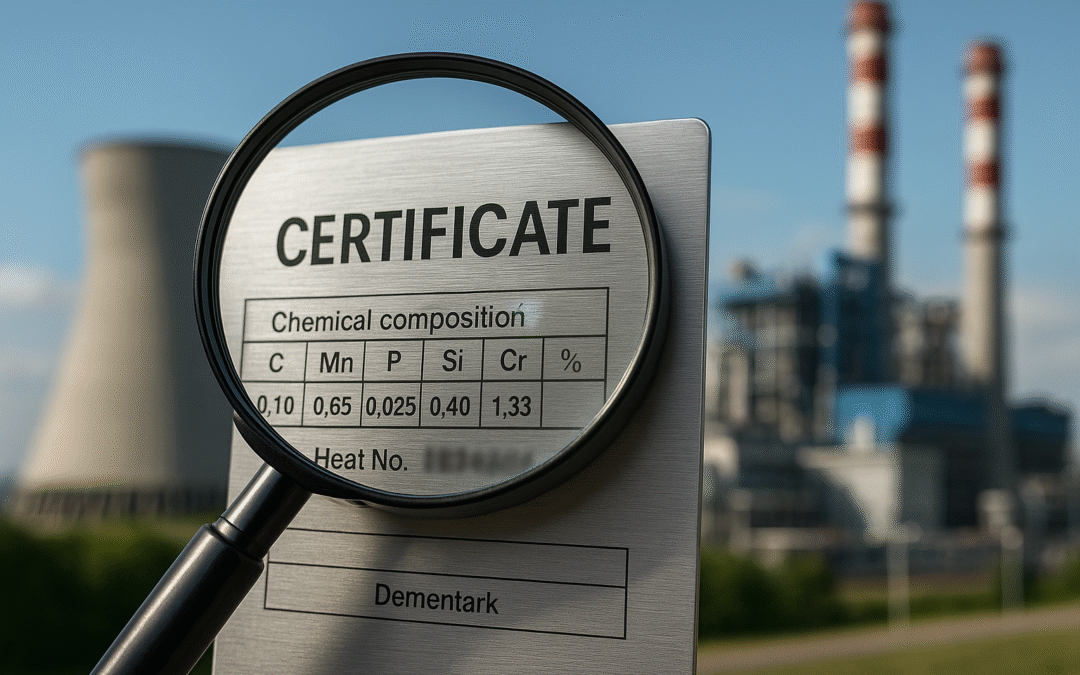
A genuine valve body or disc should have its heat number and material grade stamped on it. This heat number links the part to its Material Test Report (MTR), which lists exact chemical composition. For example, ASTM A217 WC6 must contain 0.05–0.20% carbon, 0.80–1.10% chromium, and 0.50–0.80% molybdenum. These alloying elements provide creep resistance at high temperatures. If carbon is too high, the material may become brittle; if chromium or molybdenum are low, the alloy may lack high-temperature strength. The MTR also shows the steel-making process and reference standards. When receiving valves, procurement engineers should request EN 10204 3.1 certificates with specific heat and cast numbers, and verify that the chemical analysis matches the grade and project specification.

Mechanical properties: verifying strength and ductility

Chemical composition alone doesn’t guarantee performance. Mechanical test data—yield strength, tensile strength, elongation, and impact toughness—show how the material behaves under load. ASME Section II Part D provides allowable stresses for each grade; for example, ASTM A217 WC9 has a minimum tensile strength of 585 MPa and yield strength of 415 MPa at room temperature. Impact testing ensures the material isn’t brittle at low temperatures. A relief valve used on a condensate line may see colder fluids during start-up; if the impact energy is too low, the disc or body may crack when the valve snaps open. These properties must be measured on test coupons from the same heat; they should be recorded in the MTR and cross-checked aga

Standards and certification pathways

In Europe, EN 10213 and EN 10283 cover steel castings for pressure equipment, while EN 12516 details valve design and testing. These complement EN 10204 for inspection documents. In the U.S., the National Board requires relief valves to be certified and stamped with the “NB” mark, and to be assembled by authorized assemblers. Under all regimes, the manufacturer must provide an inspection document (3.1 or 3.2) that includes chemical and mechanical test results. Type 3.2 certification, involving a third-party inspector or customer representative, is often used for high-risk or regulated equipment.

Steps to ensure compliance when purchasing relief valves

  1. Define the design conditions: Determine pressure, temperature, fluid, and service (steam, condensate, gas) to select the correct material grade and valve type (safety, relief, pilot-operated, etc.).
  2. Specify material and certificate requirements in the RFQ: State the required material grade (e.g., A217 WC6) and the mandatory certificate type (EN 10204 3.1 or 3.2). For hydrogen or sour services, specify additional testing (HIC, SSC).
  3. Review manufacturer MTRs and certificates: Upon receiving bids, request and examine MTRs. Check that the heat number on the MTR matches the stamping on valve bodies and bonnets. Compare chemical composition against ASTM/EN grade ranges and mechanical properties against code minima.
  4. Verify dimensions and wall thickness: Ensure body castings meet ASME B16.34 requirements for pressure-temperature ratings. Wall thickness influences stress and creep life.
  5. Inspect spring and trim materials: The springs, discs, and seats must also be appropriate materials (e.g., Inconel X-750 springs for high temperature service). Request MTRs for these components as well.
  6. Conduct third-party or purchaser witness testing: For critical applications, witness hydrostatic and seat leakage tests. Confirm set pressure and blowdown meet API 527 limits.
  7. Document heat number traceability: Keep a register linking each valve’s heat number to its MTR and installation location. This is vital for future audits or replacements.
  8. Audit suppliers: Visit foundries or machining shops to ensure they maintain proper heat identification throughout machining, assembly, and testing.

Common pitfalls and red flags

Despite clear procedures, problems still arise. Some suppliers deliver valves with EN 10204 2.2 test reports masquerading as 3.1, or MTRs that list generic chemistry values not specific to the delivered heat. Others use incorrect seat or spring materials that cannot handle temperature extremes. In worst cases, unscrupulous vendors replace original bodies with cheaper castings after factory inspection, or mis-stamp heat numbers to hide mixing of heats. Watch for MTRs with identical values across multiple orders, or mechanical test results copied from literature rather than from actual tests. A sudden increase in valve weight or finish may signal substitution. When in doubt, request chemical and PMI testing at receipt.

Case study

A combined cycle plant in the Midwest purchased a batch of safety relief valves for its high-pressure feedwater system. The specification required ASTM A217 WC6 bodies and EN 10204 3.1 certification. Due to schedule pressure, procurement accepted the vendor’s promise that certificates would follow. Once installed, several valves started weeping during commissioning. Investigation revealed that the bodies were made from a low-alloy steel with insufficient chromium and molybdenum. The vendor had used leftover castings from another project and re-stamped them. The MTRs were generic 2.2 declarations with no heat number. The weeping was due to accelerated corrosion and inadequate mechanical strength. The client had to replace all valves at their own cost and delay plant startup. This could have been prevented by insisting on 3.1 certificates and verifying heat numbers before installation.

Conclusion: turning compliance into reliability

Safety relief valves are not commodity items. They are engineered pressure-retaining devices whose performance depends on the chemical and mechanical integrity of every component. In a combined cycle plant, a single valve failure can shut down a turbine or, worse, cause a safety incident. By demanding EN 10204 3.1/3.2 certificates, cross-checking chemical and mechanical data against codes, and ensuring heat-number traceability, owners and EPCs protect themselves from hidden liabilities. As an independent compliance consultant, I help clients interpret MTRs, audit valve suppliers, and set up systems for verifying certificates and heat numbers. If you’re procuring critical valves or replacing them in an existing plant, reach out. Together, we’ll ensure that the protective devices you rely on are as reliable as the plant you’re building.inst code requirements.fatigue failure.

Ensuring Safety Relief Valves Meet Chemical and Mechanical Requirements

Avoiding Counterfeits: Spotting Fake Mill Test Reports and Heat Numbers

Introduction

Counterfeit mill test reports (MTRs) and forged heat numbers are serious risks for combined cycle power plants and substations. In an industry where piping and pressure equipment operate at high pressure and temperature, even a small deviation in material quality can lead to catastrophic failure. Unfortunately, unscrupulous suppliers sometimes provide documentation that looks legitimate but does not correspond to the actual materials delivered. This post explains how these counterfeit documents arise, what an authentic MTR should contain, how to recognise red flags, and what steps procurement and quality professionals can take to verify documentation.

Why Counterfeit Certificates Exist

Counterfeiting of mill test reports thrives where there is a lack of oversight and a strong incentive to cut costs. Small workshops or traders may mix heat numbers, mislabel material grades or fabricate documentation to move stock quickly. Some may not fully understand the importance of traceability and think that any certificate will satisfy the buyer. Others knowingly falsify documents to hide the fact that they are supplying a lower grade material than specified. In global supply chains, language barriers, different standards and varied levels of regulatory enforcement further contribute to the problem. When equipment is shipped halfway across the world, verifying authenticity becomes more challenging.

What a Genuine MTR Contains

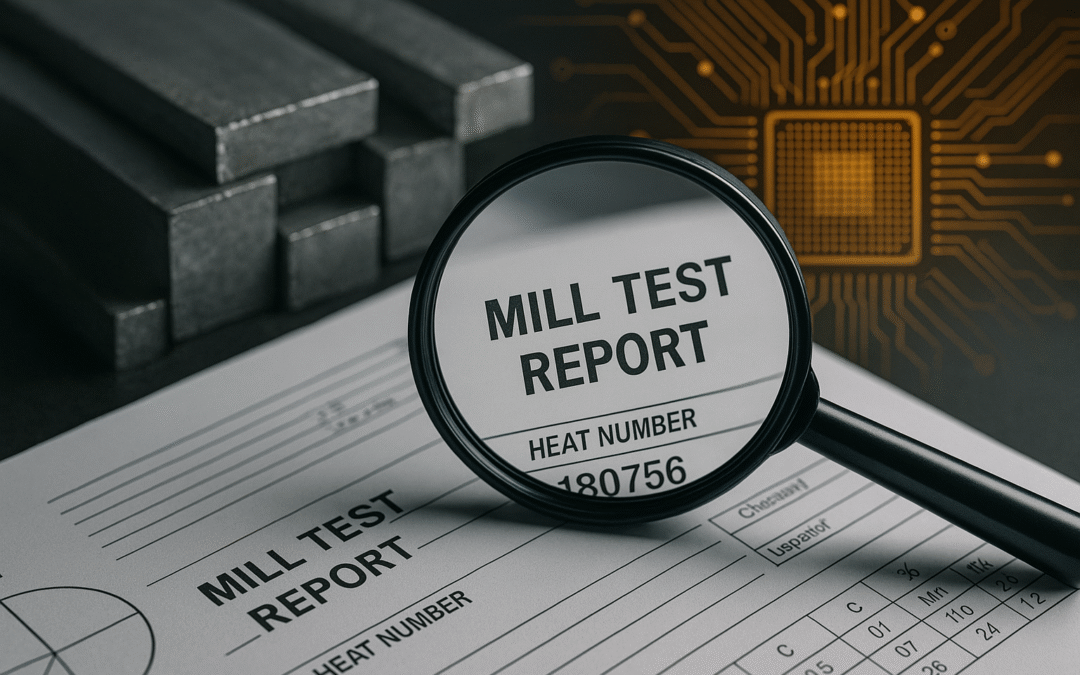
A genuine mill test report is more than a piece of paper. It is a formal document that records the chemical composition and mechanical properties of a batch of steel or alloy. The report should clearly state:

  • The specification and grade (such as ASME SA-335 P91 or EN 10216-2).
  • The heat number, which identifies the specific melt or batch of material from which the product was made.
  • The chemical composition, with the measured percentages of elements like carbon, chromium, nickel, molybdenum and vanadium.
  • Mechanical properties such as tensile strength, yield strength and impact values tested at specified temperatures.
  • The type of inspection certificate, for example EN 10204 3.1 or 3.2, and the relevant norms used for testing.
  • Signatures or stamps from the manufacturer’s quality assurance department or an independent inspector.

This data should align with the requirements of the purchase order and applicable codes. Values should fall within permissible ranges, and any supplementary requirements specified by the client should be referenced.

Red Flags for Fake Documents

There are several common signs that a mill test report or heat number may be fake or manipulated. Identical chemical and mechanical values repeated across different orders or heats are a major warning sign; in reality, there will always be slight variation. Heat numbers on the paperwork that do not match the marking on the actual component indicate a break in traceability. Look out for inconsistent fonts or file names that suggest the document has been copied and edited. If the certificate claims to be an EN 10204 3.1 or 3.2 document but lacks any reference to the testing standard or has no inspector’s signature, it is likely not valid. Another red flag is when there is no test temperature noted for impact results or when high-temperature creep properties are missing even though these were required.

Verifying Heat Numbers

Heat numbers are a key part of the traceability chain. These numbers are usually stamped or engraved directly on the material or product. When you receive a shipment, check that the heat number on the physical item matches the number on the MTR. If there are multiple pieces with different heat numbers, each one should have its own certificate. Beware of situations where a fabricator has cut and welded materials from different heats but only provides a single MTR; each heat needs its own documentation. In cases where stamping may have been removed during machining, the supplier should provide a method of transferring the heat number, such as a traveller or log sheet. If in doubt, request confirmation from the original mill or arrange for a third-party witness test.

Steps to Verify Certificates

Procurement and quality teams can take practical steps to minimise the risk of receiving counterfeit documentation. First, always request EN 10204 3.1 or 3.2 certificates for pressure parts and safety-critical items. Second, cross-check the chemical composition and mechanical properties against the relevant specification; if the values fall outside the permitted range, reject the material. Third, verify that the heat number on the item matches the number on the certificate and that the certificate lists the correct product form and dimensions. Fourth, look for the testing standards cited on the report (such as ASTM A370 for mechanical tests). If the supplier has not indicated the standard or has referenced outdated standards, ask for clarification. Finally, when large quantities of material are involved, consider random sampling and testing by an independent laboratory to confirm the chemical composition. This may seem burdensome, but it is far less costly than dealing with a failure later.

Case Study: The Cost of Not Verifying

A combined cycle plant in South Asia once purchased a batch of high-pressure boiler tubes that came with what appeared to be EN 10204 3.1 certificates. The plant’s quality control department relied on the paperwork and did not perform any further checks. Within months of commissioning, several tubes ruptured, causing an unplanned shutdown. Investigation revealed that the tubes were actually made from a lower grade material and had inadequate creep strength. The MTRs had been copied from genuine certificates but the heat numbers had been altered. Had the plant required third-party verification or performed random chemical analysis, the issue would have been caught before installation.

Conclusion

In a market flooded with suppliers of varying reliability, you must treat mill test reports and heat numbers with the same scrutiny you would give to a safety inspection. Counterfeit documentation is not always easy to spot, but simple checks—matching heat numbers, verifying chemistry and mechanical data, insisting on proper certificate types and looking out for inconsistencies—can protect your project. As an independent compliance consultant, I specialise in helping owners and engineers implement these checks. If you want peace of mind that your materials are what they claim to be, reach out for a review of your next purchase order or a training session for your team. Authentic materials are not just a requirement; they are the difference between smooth operations and costly failures.

How to Verify EN 10204 Certificates for Power Plant Equipment

How to Verify EN 10204 Certificates for Power Plant Equipment

Ensuring that every pressure part and safety component in a power plant has the right certification isn’t just a bureaucratic exercise—it’s a matter of safety, reliability and compliance. EN 10204 is the European standard that governs inspection documents for metallic materials. Understanding the different certificate types, and knowing how to verify them, helps procurement and quality teams avoid counterfeits and meet contractual and regulatory obligations.

What does EN 10204 cover?

EN 10204 classifies inspection documents into four levels. A Type 2.1 declaration is simply a statement of compliance without test results. A Type 2.2 test report includes non-specific test data based on samples from the same grade but not the same batch. A Type 3.1 inspection certificate includes specific tests on the actual batch delivered and is signed by the manufacturer’s QA representative, independent from production. A Type 3.2 inspection certificate goes further by adding verification by either a third-party inspector or the purchaser’s nominated representative.

For critical pressure parts, valves, flanges and piping in combined-cycle plants and substations, 3.1 should be the minimum requirement. For items covered by regulatory requirements or owner‑engineer specifications, a 3.2 certificate may be mandated. Anything less offers no specific test data and therefore no reliable traceability.

Steps for verifying EN 10204 certificates

  1. Confirm the certificate type. Look for the clearly printed designation (e.g., “Inspection certificate 3.1 to EN 10204”) on the document. If the certificate claims to be EN 10204 but does not specify a type, or if it only provides a generic statement of compliance, it does not meet the requirements.
  2. Match the heat numbers. The heat number stamped on the material should match the heat number listed on the certificate. Each component should trace back to its furnace batch. If the certificate lists multiple heats but the parts are stamped with only one number, ask the supplier for clarification and additional documentation.
  3. Check the chemical composition. Compare the chemistry values on the certificate against the specification or code requirements (ASME, ASTM, EN or customer spec). Watch for elements outside their permitted ranges. In high-temperature service, even small deviations in chromium, molybdenum or carbon can significantly reduce creep strength.
  4. Review mechanical properties. Ensure that tensile strength, yield strength and impact values are reported. For components operating at low temperatures, verify that impact tests have been carried out at the correct temperature and that the results meet the minimum energy criteria.
  5. Verify the test standards and sampling. A 3.1 or 3.2 certificate should reference specific test standards (e.g., EN ISO 6892–1 for tensile tests, EN ISO 148–1 for impact tests) and indicate the sampling location and orientation. Generic descriptions such as “tests performed according to applicable standards” are insufficient.
  6. Look for independent signatures. A legitimate 3.1 certificate is signed by the manufacturer’s authorized QA representative, separate from the production team. A 3.2 certificate includes a second signature from an independent inspector or purchaser’s representative. Unsigned or generic certificates are not valid.

Red flags that indicate potential forgeries

Even experienced buyers can be fooled by well‑produced fake certificates. Watch for these warning signs:

  • Identical data across multiple certificates. If chemistry and mechanical values are exactly the same for different heats or products, it may indicate copy‑paste rather than actual test results.
  • Inconsistent formatting or fonts. A certificate that looks patched together from different sources may have been altered.
  • Heat numbers that do not match physical markings. Always cross‑check the number stamped on the component against the certificate.
  • Certificate types that change between pages. A document that says “Test report 2.2” on one page and “Inspection certificate 3.1” on another is suspect.

If you see any of these anomalies, request clarification and, if necessary, new documentation or replacement parts. Do not accept verbal assurances; the entire purpose of EN 10204 is to provide written, traceable evidence.

Why verification matters for power plants

In high‑energy applications, failure of a pressure boundary or safety valve can lead to catastrophic damage and long outages. Using materials without verified certificates increases the risk of premature failure, invalidates warranties and can lead to non‑compliance with regulatory bodies. In the worst case, it exposes owners and contractors to legal liability.

By adopting a disciplined process for verifying EN 10204 certificates—checking the certificate type, matching heat numbers, confirming test results and watching for red flags—you reduce these risks and build a culture of quality. If your team lacks the time or expertise to perform these checks, consider engaging an independent compliance consultant who specializes in material certification.

Call to action

If you need assistance reviewing supplier documentation or drafting RFQ language that demands proper certification, I can help. Together we can ensure that every component in your plant has a transparent trail from the furnace to your facility, safeguarding performance and compliance.